Measurement of your space is one of the first things you must get right when planning on installing new flooring. If you don’t figure out square footage correctly, you may purchase an excessive amount of material or, even worse, a small amount. This usually results in a waste of money, unnecessary visits to the store and time wastage in finishing your project.
You can be renovating a single room or doing a complete overhaul of your home; everything becomes simple when you get the correct measurements. It also assists you in comparing the costs of materials and how to remain in your budget. Even the slightest miscalculation can influence the whole project and thus it is better to be accurate at the very beginning. This guide has a very easy and practical method to calculate your space and estimate the cost of flooring with ease.
What is Square Footage?
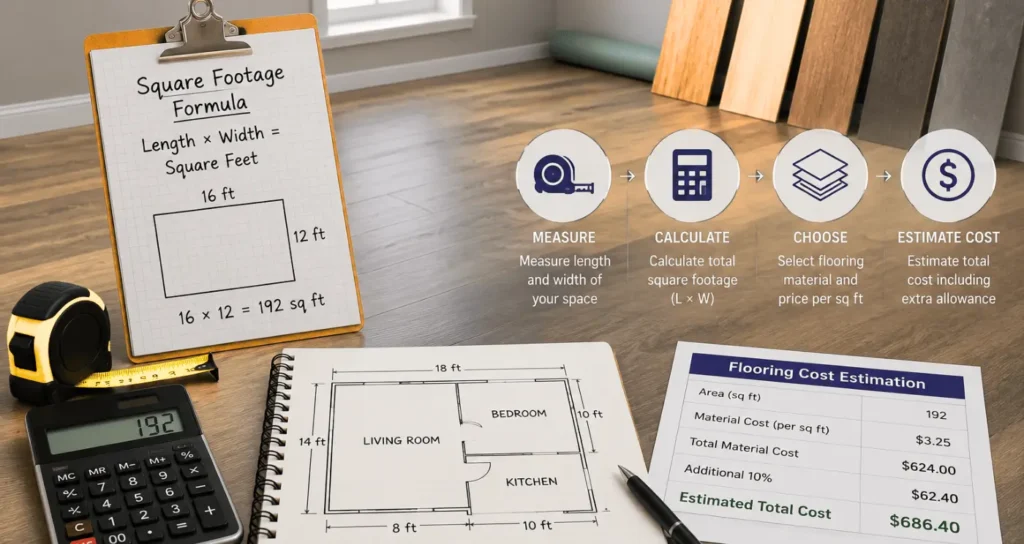
The total area of space is just another term used to denote square footage. It informs you of the amount of surface you have by multiplying the length and the width of a room. This unit is typically measured in square feet and is popular in construction, real estate, and home improvement projects. As an example, a room that is 10 feet in length and 12 feet in width has a square footage of 120 square feet. This number is critical in purchasing flooring materials because most products are packaged in terms of area. It provides you with a clear picture of what quantity of materials you will require in your project.
Tools You Need Before Measuring
Some basic tools are required before you begin to measure your space to be covered by flooring. By being prepared beforehand, you can complete your project in less time and with less effort and prevent errors in making measurements that will be correct.
- Measuring Tape
- Calculator
- Notepad or Paper
- Pencil or Pen
- Mobile Phone (optional)
Having these basic tools, you will be able to measure your room more precisely and keep in order the process. Getting ready ahead of time will save time and eliminate the possibility of making a mistake that would lead to errors in the estimate of your flooring.
How to Figure Out Square Footage for Flooring (Step-by-Step)
The measurement process of your flooring area in steps will help you to get the correct results and prevent waste of materials. Before purchasing flooring materials, follow every step to make sure your calculation is right and easily comprehensible.
Step 1: Measure the Length and Width
Measure the length and width of the room with a measuring tape. Make sure to measure from wall to wall accurately. Record the measurements since any minute mistakes may impact your overall calculation of the flooring and the estimate of the material.
Step 2: Multiply to Get Area
After getting the length and width, multiply them to obtain the total area of the room. As an illustration, square footage = length x width. This basic equation is used to get a quick grasp of the size of the area that you are dealing with.
Step 3: Calculate Multiple Rooms Separately
When you have more than one room in your house, then measure them separately. Do not add measurements at this step. Breaking down further would be accurate and would enable you not to mix up when estimating the flooring needs in various areas.
Step 4: Add All Areas Together
Once you have the square footage of each of the rooms, sum up all the space. This provides you with the overall flooring requirement of the whole space. This last figure assists you in planning your material purchase and budget better.
With a few simple steps, you can be able to figure out your total flooring area with ease. Proper measurements will make you not spend additional money and plan your flooring project properly and efficiently.
How to Handle Different Room Shapes
The dissimilar shapes of rooms necessitate marginally varied methods of determining flooring area. Knowing how to work with each shape will enable you to approach your total calculation more precisely and prevent errors.
- Rectangular Rooms
The rectangular rooms are easiest to measure. All one needs to do is to multiply the length and the width of the room. This makes all corners straight, thus providing you with true square footage without requiring any additional calibration to arrive at the same.
- Square Rooms
Square rooms are equal on all sides and thus only one side is to be measured. Take the same value and multiply it by the same value to get the area. This renders square rooms very easy and fast to compute when it comes to flooring.
- L-Shaped Rooms
L-shaped rooms are to be separated into two smaller rectangles. Divide each section into parts, find the areas of each part and add them. This technique will allow you to deal with complex layouts without losing precision in your flooring estimate.
- Irregular Shapes
The irregular forms of rooms may be subdivided into several simple forms such as rectangles or squares. Measure all parts separately, find the area of each part and then add all the values. This is done in a step-by-step manner, making even complicated spaces easier to measure appropriately.
Knowing how to measure various shapes of rooms correctly, you can be more accurate in your flooring calculations. This will keep you from overstocking and understocking materials and will keep your project on track.
How to Estimate Flooring Cost
One of the key steps in budgeting your project is estimating the cost of flooring. With the total area known, it is easy to determine the amount of money that you will require in materials and installation.
Step 1: Find Cost Per Square Foot
Begin by verifying the cost of each square foot of the flooring material. The rates of different materials such as tile, wood, or vinyl are different. Being aware of the exact price per square foot assists you in determining a realistic budget prior to undertaking your flooring project.
Step 2: Multiply by Total Square Footage
Once you have the total square footage of your space, multiply the total square footage by the square foot cost. This provides you with the material cost. This action will make you realize the amount of money you will be spending on flooring materials only.
Step 3: Add Labor and Additional Costs
Lastly, add labor costs and any additional expenses such as adhesive, underlayment, or delivery fees. These expenses will add up to the total amount you are likely to spend on your flooring project to be able to have a more realistic budget.
By carefully calculating each part of the cost, you can avoid unexpected expenses and stay within your budget. An accurate estimate makes your flooring project a hassle-free financial plan.
Common Mistakes to Avoid
Another factor to consider before calculating your flooring area is to prevent some of the most common errors, which result in failed calculations and unnecessary costs. Caution at this point will assist you in receiving the correct results and planning your project in a better way.
- Failure to measure accurately along the wall-to-wall.
- Leaving out any detail of rooms.
- Disregarding irregular corners or spaces.
- Skipping the waste/material buffer
- Inappropriate units (feet vs. inches).
These are some of the common mistakes that can be avoided to save time and money in the course of your flooring project. Measurement can make your estimate of material accurate and also can make you finish your work without unwarranted delays or insufficiency.
Use a Square Footage Calculator
When estimating your space, the best and quickest method to use is the online calculator to calculate your square footage when planning a flooring project. You can save time on calculations by just typing in the length and width of your room and having real-time results. This can save you time, lessen mistakes, and make your planning a lot easier. It comes in particularly handy when you are dealing with several rooms, varied shapes, or big areas and you end up confused with the manual math.
When you are in a hurry and need a fast and trustworthy method of planning your flooring, you can utilize a square-footage calculator on our site to get accurate results in just a few seconds and make superior decisions on what material and budget to use before commencing your project.
Conclusion
Understanding how to plan your flooring project properly can save you both time and money. Improper Figure Out Square Footage can result in excessive wastage of materials, but with correct calculation, it is much easier to determine the precise quantity of material you require. Proper measurements can also assist you in maintaining your budget and avoiding last-minute rushes, or unnecessary buying. Be it only one room or a complete house, being careful when taking measurements helps to make the entire process much easier and efficient.
With the help of the steps given in this guide, you can be sure you can cope with any flooring job without getting lost. Always check and recheck your measurements and calculations so that you can have the best results and a smooth sailing experience.
FAQ’s
Q1. How can I Figure Out Square Footage of a room?
Calculate the length and width of the room in feet and multiply the two numbers to obtain the total square feet.
Q2. Do I need to include closets and small spaces?
Yes, you are to include all the usable floor areas such as closets and minor areas in order to get the correct total floor area.
Q3. What if my room is not a perfect square or rectangle?
Break the room into smaller, simple shapes, and find the area of each shape individually, then add them up.
Q4. Why should I add extra square footage when buying flooring?
Additional content includes waste cutting, errors, and repairs in the future; typically 5-15 percent is suggested.
Q5. Is it possible to calculate square footage without using a calculator?
Yes, it can be calculated manually, but the accuracy and speed of determining square footage can be achieved by using a tool or formula.